|
Family: |
Iridaceae |
|
Place of publishing: |
Fl. Dalm. 1: 119 (1842) |
|
Synonyms: |
Crocus reticulatus var. dalmaticus (Vis.) Herb. |
|
Common names: |
dalmatian crocus |
|
Description: |
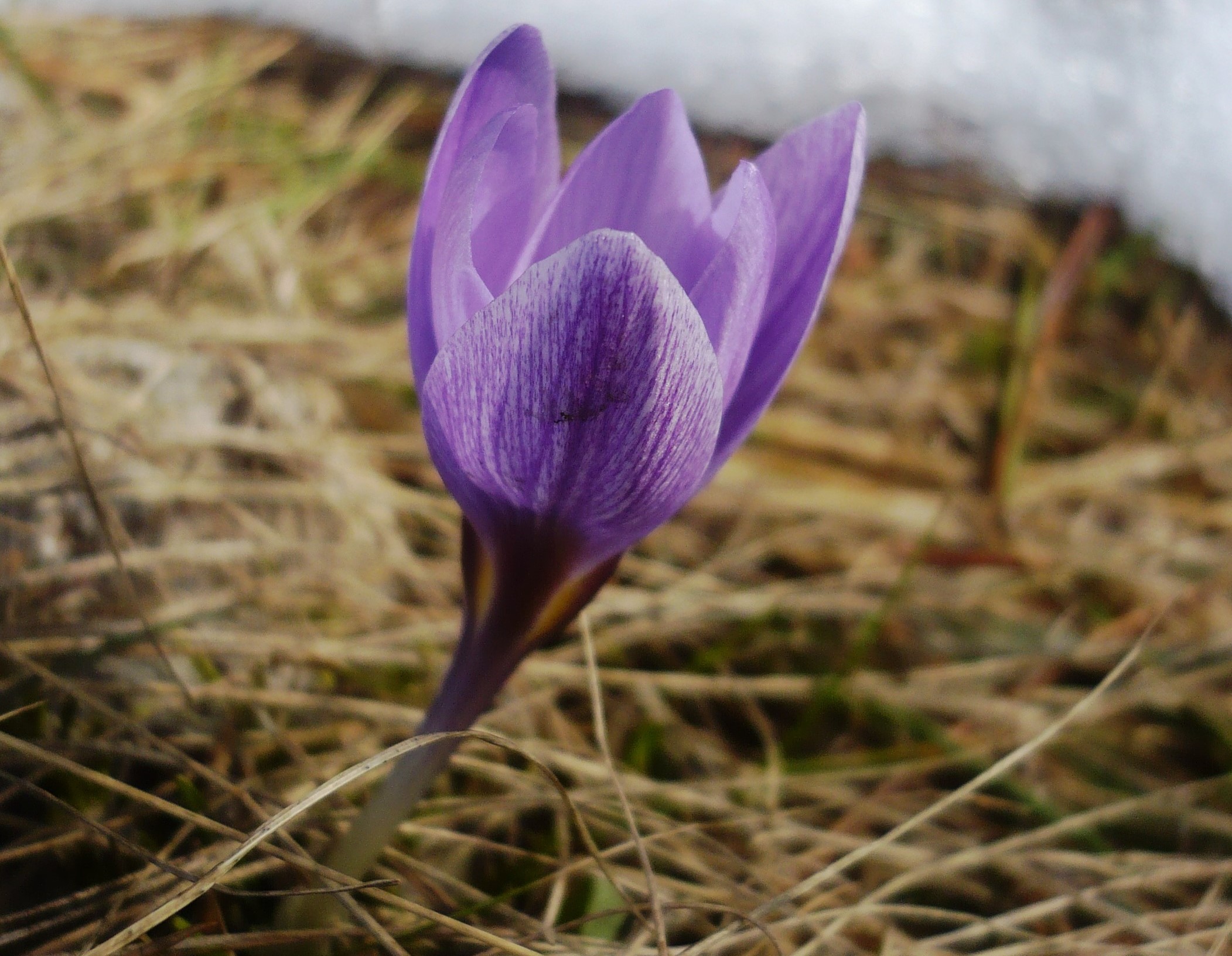
Perennial herbaceous plant 10-20 cm tall with a
tuber 8-12 mm long, the stem of which is fibrous. The fibers are strong and
mesh-woven. The stem and leaves are covered with 3-4 thin membranous branches
1.5-6.5 cm long. As a rule, the plant has 3-4 narrow linear leaves, 1-2 (-3)
mm wide, they reach the throat of the perigon in height, and they appear at
the same time as the flowers. The leaves are green, with a white stripe in
the middle, with the edges curled towards the inside. The plant has no basal
spathe. Bracteia and bracteole are of equal length (4-5 cm), papery
membranous, surpassing the longest sleeve. It usually has 2 flowers, the
inflorescence is blue-violet, the pharynx is yellow, the tube of the
inflorescence is 4-6 cm long, blue striped, the snout is as high as the
stamens or exceeds them, deeply three-parted. Pharynx sparsely hairy, no leaf
sheath, inflorescence segments 1.5-3.5 x 1-1.5 cm. Flowers from January to
April. The fruit is a quiver, elliptical in shape, about 1.8 cm long, opens
with three flaps. It contains several light brown ellipsoid seeds (3-4 mm). |
|
Flowering season: |
From January to April. |
|
Habitat: |
It grows primarily on sunny karst rock fields in the
Mediterranean, sub-Mediterranean and montane-Mediterranean areas. |
|
General distribution: |
It is an endemic species of the Dinarides. |
|
Threat status: |
The species is on the Red List of Flora of FBiH (Đug
et al., 2013) under the category LC - species of least concern. Also, it is
on the Red List of the flora of the RS (Anonymus, 2012). |
|
Attractions: |
The Dalmatian crocus is morphologically most similar
to the variegated crocus (Crocus reticulatus Steven ex Adam) after the new
Crocus variegatus Hoppe et Hornsch. (Milović, 2016), from which it is
distinctly distinguished by the monochromatic flowers and slightly duller
leaves of the inflorescence. |
|
Basic literature |
Visiani, R. (1842). Dalmatian flora. Vol. 1. Apud
Friedericum Hofmeister, Lipsiae. Pulević, V. (1979). Contribution to the knowledge of
the genus Crocus L. in Yugoslavia (divisio Nudiflori sectio Reticulati).
Gazette of the Republic Institute for Nature Protection - Natural History
Museum Titograd 12: 195-212. Šilić, Č. (1984). Endemic plants. Institute for
textbooks and teaching aids, Svjetlost, Belgrade, Sarajevo. Šilić, Č. (2002). Endemic and rare plants of the
Blidinje Nature Park. Matica Croatia, Čitluk Branch. Anonymous
(2012). Red list of protected species of flora and fauna of the Republic of
Srpska. Retrieved from: http://nasljedje.org/prirodno-nasljedje/202;
available 07/02/2023. Đug, S., Muratović, E., Drešković, E., Boškailo, A.,
Dudević, S. (2013). Red list of the flora of the Federation of Bosnia and
Herzegovina. Draft report - Proposal. Project of Forest and Mountain
Protected Areas, "NGO Green way" and "Federal Ministry of
Environment and Tourism", Sarajevo. pp. 1- 347. Milović, M. (2016). The genus Crocus L. (Iridaceae)
in the flora of Croatia. Voice. Croat. bot. mate. 4(2): 4-20. Boskailo, A., Boskailo, S. (2023). Flora of the City
of Mostar. Monograph. (Manuscript). Boskailo, S. (2023). Application of remote sensing
for the purpose of identification and mapping of habitat types of the future
Trebižat protected area. Master's thesis. Teaching Faculty of the University
"Džemal Bijedić" in Mostar, Mostar. |