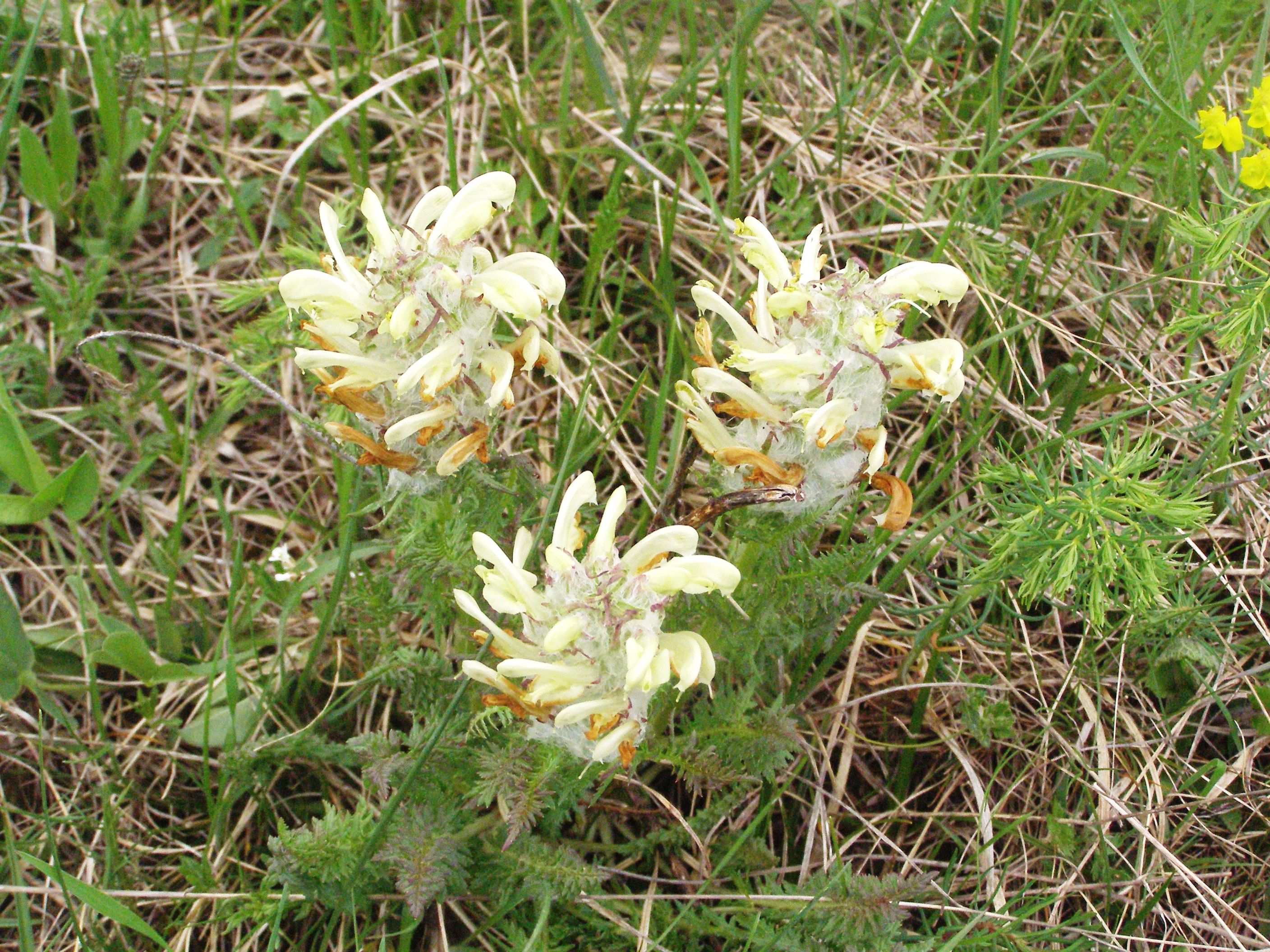
Pedicularis brachyodonta Schloss. et Vuk.
|
Family: |
Orobanchaceae |
|
Place of publishing: |
Syll. Fl. Croat.: 89. (1857) |
|
Synonyms: |
Pedicularis comosa subsp. brachyodonta (Schloss.
& Vuk.) Nyman, Pedicularis bracyodonta subsp. brachyodonta Hayek |
|
Common names: |
- |
|
Description: |
Root with spindle-shaped thickened veins. Stem erect
or erect, unbranched, four-edged, hollow, covered with hairs. Ground leaves
with a petiole, up to 20 cm long, pinnately divided, and the lobes are
linear-lanceolate. Stem leaves ovate, doubly pinnately divided or only
pinnately cut. In the area of flowering, the leaves gradually turn into
flowering leaves, pinnately divided or whole. Flowers united in an elongated
raceme, up to 20 cm high, which is cut at the top. Flowers large, light
yellow. Calyx inflated at the base, hairy, round with 4 teeth of almost equal
length, covered with woolly hairs around the rim. Corolla 20 – 25 mm long,
smooth, the upper lip bent in the form of a helmet, without a beak or with a
very short beak, and a head-shaped snout pistil protrudes from under the
helmet. The lower lip is three-lobed, and the lobes are rounded and serrated.
Capsule erect, more or less ovoid, longer than the calyx. |
|
Flowering season: |
From June to August. |
|
Habitat: |
It grows on mountain mines on limestones of the
order Crepidetalia dinaricae (urumovii) Lakušić 1966. |
|
General distribution: |
It is an endemic species of the Dinarides with a
center of distribution in the area of the Balkan Peninsula. |
|
Threat status: |
The species is on the Red List of FBiH flora (Đug et
al., 2013) under the category VU - vulnerable species. |
|
Attractions: |
An extremely variable species that includes a large
number of subspecies, varieties and forms. |
|
Basic literature |
Mayer, E. (1972). Pedicularis L. In: Tutin et al.
(eds.): Flora Europaea. Vol. 3: 269–276, Cambridge University Press,
Cambridge. Šilić, Č. (1984). Endemic plants. Institute for
textbooks and teaching aids, Svjetlost, Belgrade, Sarajevo. Šilić, Č. (2002). Endemic and rare plants of the
Blidinje Nature Park. Matica Croatia, Čitluk Branch. Marhold, K. (2011+). Pedicularis. In: Euro+Med
Plantbase - the information resource for Euro-Mediterranean plant diversity.
http://ww2.bgbm.
org/EuroPlusMed/PTaxonDetail.asp?NameCache=Pedicularis&PTRefFk=7200000
[accessed 10th July 2023] Đug, S., Muratović, E., Drešković, E., Boškailo, A.,
Dudević, S. (2013). Red list of the flora of the Federation of Bosnia and
Herzegovina. Draft report - Proposal. Project of Forest and Mountain
Protected Areas, "NGO Green way" and "Federal Ministry of
Environment and Tourism", Sarajevo. pp. 1- 347. Mihelj, D., Šoljan, D. (2015). Historical review of
research on the genus Edraianthus A. DC. (Campanulaceae) in the flora of
Bosnia and Herzegovina. Natural Sciences, Journal of the Department of
Natural Sciences and Mathematics of Matica Hrvatska, 15(1-2): 205-224,
Sarajevo. Šoljan, D. (2023). Endemic flora of the mountains in
the vicinity of Sarajevo. Dobra knjiga d.o.o., Sarajevo. Boskailo, A., Boskailo, S. (2023). Flora of the City
of Mostar. Monograph. (Manuscript). |